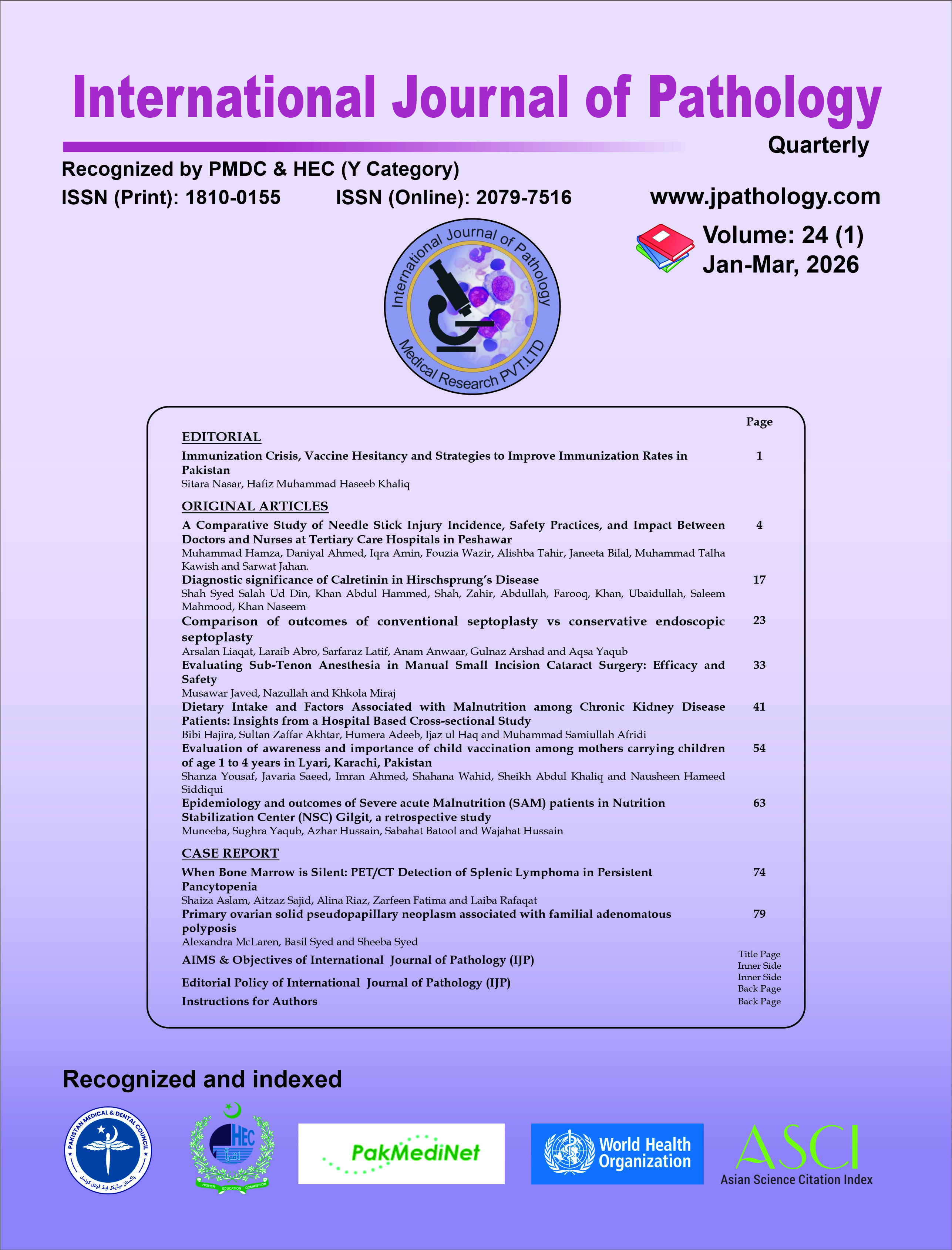
Evaluating sub-tenon anesthesia in manual small incision cataract surgery: efficacy and safety
DOI:
https://doi.org/10.59736/IJP.24.01.1047Keywords:
Sub-Tennon , Cataract , MSIC , Ophthalmic anesthesiaAbstract
Background: Cataract remains the leading cause of preventable blindness worldwide. While local anesthesia is essential for cataract surgery, traditional techniques like peribulbar and retrobulbar blocks carry significant risks. Sub-Tenon anesthesia has emerged as a potentially safer alternative, though its efficacy rates vary widely in literature, and data from the local population is limited. Our objective is to evaluate the efficacy and safety of Sub-Tenon anesthesia in patients undergoing Manual Small Incision Cataract Surgery (MSICS) at a tertiary care hospital in Peshawar, Pakistan.
Methods: This descriptive case series was conducted at the Department of Ophthalmology, Hayatabad Medical Complex. A total of 148 patients undergoing MSICS under Sub-Tenon anesthesia were enrolled using non-probability consecutive sampling. Akinesia was assessed using a standardized scoring system (0-12) ten minutes after anesthetic administration, with complete akinesia (score=0) defined as effective. Secondary outcomes included intraoperative pain (measured using the 10-point Visual Analog Scale (VAS; 0 = no pain, 10 = worst possible pain), surgical duration, and adverse events. Data were analyzed using SPSS version 24 with appropriate statistical tests.
Results: The overall efficacy of Sub-Tenon anesthesia was 56.1% (83/148). Patients with effective blocks reported significantly lower pain scores (median VAS: 1.30 vs 3.90, p<0.001) and had shorter surgical duration (median: 26 vs 33 minutes, p<0.001). Multivariate analysis showed that lower pain scores (adjusted OR: 0.11, 95% CI: 0.05-0.21, p<0.001) and shorter surgery duration (adjusted OR: 0.91, 95% CI: 0.82-0.99, p=0.031) were significantly associated with effective anesthesia. The technique demonstrated favorable safety profile with only minor, self-limiting adverse events (overall incidence: 4.1%).
Conclusion: Sub-Tenon anesthesia provides moderate efficacy with exceptional safety for MSICS. Successful blocks are associated with significantly improved patient comfort and surgical efficiency. This technique represents a viable alternative to sharp-needle approaches, particularly in settings prioritizing patient safety.
References
Chen SP, Woreta F, Chang DF. Cataracts: a review. JAMA. 2025. In press.
Surico PL, Rossi T, Romano MR, Cagini C, Iannetta D. Sustainability in cataract and refractive surgery: current challenges and future perspectives. J Ophthalmol. 2025; 2025:4632626.
Bali J, Bali O. Essentials of ocular anaesthesia: techniques, indications, andcomplications.In:Anesthesiology— insights. London: Intech Open; 2025.
Koshy TA. A study comparing the effectiveness and side effects of subtenon's anesthesia using flexible 22G IV pediatric cannula versus peribulbar anesthesia dissertation. India: Rajiv Gandhi University of Health Sciences; 2020.
Ginsburg RN, Duker JS. Globe perforation associated with retrobulbar and peribulbar anesthesia. Semin Ophthalmol. 1993;8(1):26-33.
Chua MJ, Seow W, Shen J, Wang CY. Sub-Tenon's anaesthesia for modern eye surgery—clinicians' perspective, 30 years after re-introduction. Eye. 2021;35(5):1295-1304.
Lozada GA, Macias AA. Eye blocks. In: Regional anesthesia and acute pain medicine: a problem-based learning approach. Oxford: Oxford University Press; 2023. p. 117-29.
Kadhum M, Alshehri A, Alghamdi S, Jambi S. Operative outcomes for wide awake local anesthesia versus regional and general anesthesia for flexor tendon repair. Hand Surg Rehabil. 2022;41(1):125-30.
Reddy M. A detailed comparison of topical anesthesia and sub-Tenon block in ensuring patient comfort during cataract surgery dissertation. India: Rajiv Gandhi University of Health Sciences; 2019.
Kumar V. A comparative study of sub-Tenons anaesthesia versus peribulbar anaesthesia in manual small incision cataract surgery at Hanagal Shri Kumareshwar Hospital and Research Centre, Bagalkot dissertation. India: Rajiv Gandhi University of Health Sciences; 2016.
Jongsareejit A, Jirasuwankul N, Wuthisiri W. Cost-effectiveness analysis of manual small incision cataract surgery (MSICS) and phacoemulsification (PE). J Med Assoc Thai. 2012;95(2):212-9.
Hayatabad Medical Complex. Official website. Available from: https://www.hmckp.gov.pk/.
Fasih U, Shaikh M, Ahmed J. Safety and efficacy of sub-Tenon anesthesia in anterior segment surgeries. Pak J Ophthalmol. 2011;27(3):145-9.
Kumar HS, Patil K. A study of comparison of sub-Tenon's anaesthesia with peribulbar anaesthesia in manual small incision cataract surgery in RIMS Teaching Hospital Raichur. Int J Integr Med Sci. 2019;6(4):807-11.
Kurdi MS, Kaur M, Ganesh S, Raj K. Recent advancements in regional anaesthesia. Indian J Anaesth. 2023;67(1):63-70.
MA S, Arshad M, Khan A. Optimizing pain management: a comparative review of regional anesthesia techniques for unilateral shoulder surgeries. Egypt Rev Med Health Sci. 2025;4(1):33-40.
Chang DF. Advanced IOL fixation techniques: strategies for compromised or missing capsular support. Boca Raton: CRC Press; 2024.
Downloads
Published
Issue
Section
License
Copyright (c) 2026 Musawar Javed, Nazullah, Khkola Miraj

This work is licensed under a Creative Commons Attribution-NonCommercial 4.0 International License.
Readers may “Share-copy and redistribute the material in any medium or format” and “Adapt-remix, transform, and build upon the material”. The readers must give appropriate credit to the source of the material and indicate if changes were made to the material. Readers may not use the material for commercial purpose. The readers may not apply legal terms or technological measures that legally restrict others from doing anything the license permits.