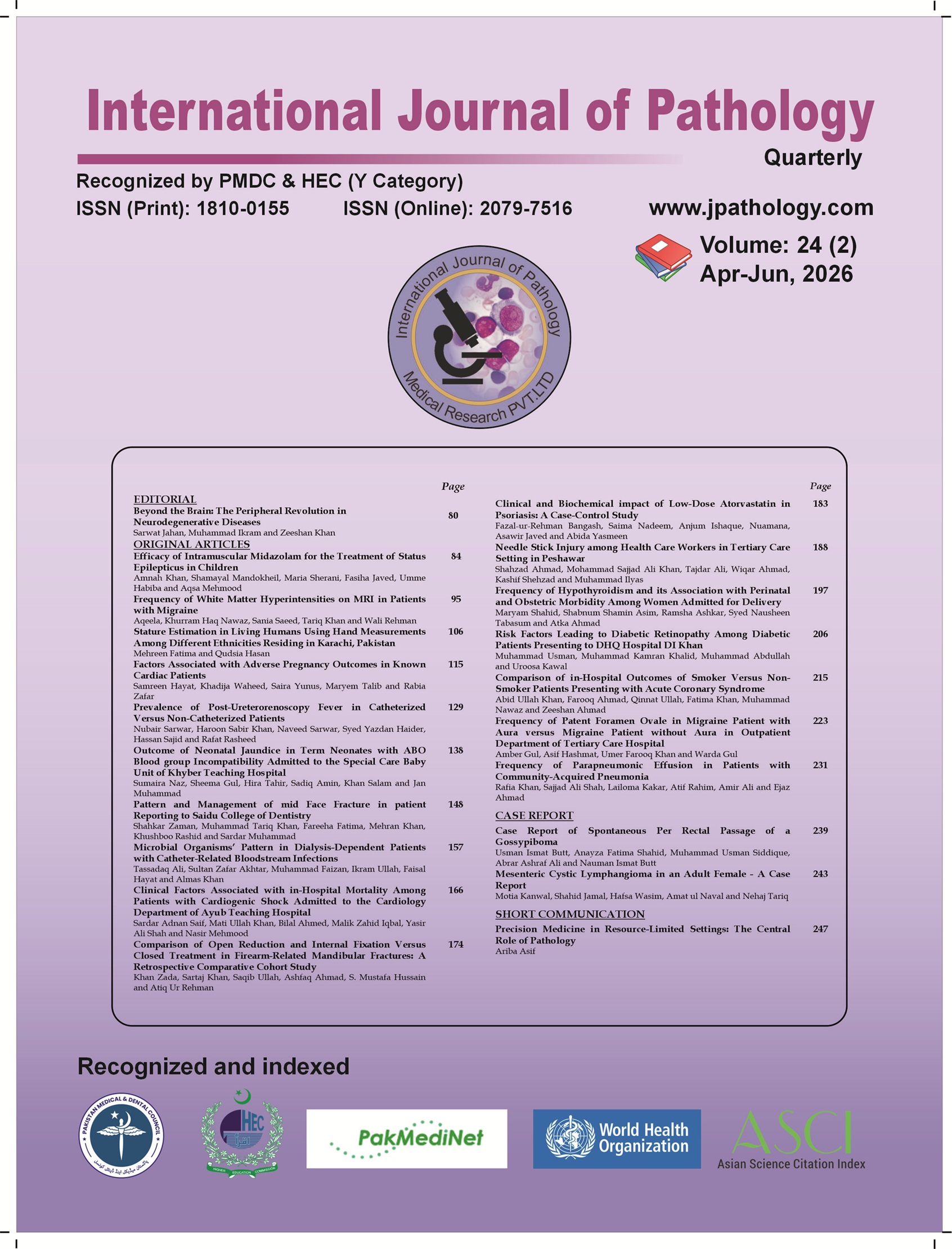
Risk factors leading to diabetic retinopathy among diabeticpatients presenting to DHQ Hospital DI Khan
DOI:
https://doi.org/10.59736/IJP.24.02.1076Keywords:
Albuminuria, Diabetic Retinopathy, Dyslipidemia, HbA1c, Hypertension, Type 2 Diabetes MellitusAbstract
Background: Diabetic retinopathy is a common microvascular complication of type 2 diabetes mellitus and a major cause of preventable vision loss. Poor glycemic control, hypertension, and prolonged diabetes duration are important risk factors associated with disease progression.
Methods: This cross-sectional study was carried out at the Department of Ophthalmology, DHQ Hospital DI Khan, over a six-month period following ethical approval. Using non-probability consecutive sampling, 166 patients diagnosed with type 2 diabetes mellitus and diabetic retinopathy were enrolled. Demographic and clinical data including age, gender, duration of diabetes, hypertension status, family history of diabetes, and HbA1c levels were recorded on a structured proforma. Fundoscopic examination was performed by a consultant ophthalmologist with a minimum of five years of post-fellowship experience. Disease severity and associated risk factors, namely dyslipidemia and albuminuria, were documented and analyzed using SPSS version 26.0.
Results: The average age of the participants was 55.44 ± 10.07 years, average HbA1c level was 8.01 ± 1.31%, and average duration of the disease was 7.40 ± 3.40 years. Hypertension was present in 74.3% of the patients, while a family history of diabetes was observed in 54.8%. The prevalence rate for each of the severity grades of retinopathy was as follows: grade 1 - 47.6%, grade 2 - 28.9%, grade 3 - 14.5%, and grade 4 - 9.0%. Total hypercholesterolemia occurred in 43.4%, LDL cholesterol elevation in 51.8%, and albuminuria in 36.1% of the patients. Stratification analysis did not show any statistically significant relationship between lipid disorders and albuminuria with the other variables considered (age, location of residence, hypertension)
Conclusion: Diabetes mellitus duration, poor glycemic control, high blood pressure, and abnormal lipid profile were the main risk factors found. Retinal examination and strict metabolic control are essential in preventing further deterioration and loss of vision.
References
Yameny AA. Diabetes mellitus overview 2024. J Biosci Appl Res. 2024;10(3):641–5.
Tomic D, Shaw JE, Magliano DJ. The burden and risks of emerging complications of diabetes mellitus. Nat Rev Endocrinol. 2022;18(9):525–39.
Antar SA, Ashour NA, Sharaky M, Khattab M, Ashour NA, Zaid RT, et al. Diabetes mellitus: Classification, mediators, and complications; A gate to identify potential targets for the development of new effective treatments. Biomed Pharmacother. 2023; 168:115734.
ZakirM, Ahuja N, Surksha MA, Sachdev R, Kalariya Y, Nasir M, et al. Cardiovascular complications of diabetes: from microvascular to macrovascular pathways. Cureus. 2023;15(9).
Mansour A, Mousa M, Abdelmannan D, Tay G, Hassoun A, Alsafar H. Microvascular and macrovascular complications of type 2 diabetes mellitus: Exome wide association analyses. Front Endocrinol. 2023; 14:1143067.
Yang Z, Tan TE, Shao Y, Wong TY, Li X. Classification of diabetic retinopathy: Past, present and future. Front Endocrinol. 2022; 13:1079217.
Yavuz DG. Classification, risk factors, and clinical presentation diabetic neuropathy. In: Diabetic neuropathy. Elsevier; 2022. p. 1–9.
Mounirou BA, Adam ND, Yakoura AK, Aminou MS, Liu YT, Tan LY. Diabetic retinopathy: an overview of treatments. Indian J Endocrinol Metab. 2022;26(2):111–8.
Ansari P, Tabasumma N, Snigdha NN, Siam NH, Panduru RV, Azam S, et al. Diabetic retinopathy: an overview on mechanisms, pathophysiology and pharmacotherapy. Diabetology. 2022;3(1):159–75.
Lundeen EA, Burke-Conte Z, Rein DB, Wittenborn JS, Saaddine J, Lee AY, et al. Prevalence of diabetic retinopathy in the US in 2021. JAMA Ophthalmol. 2023;141(8):747–54.
Benhamza M, Dahlui M, Said MA. Determining direct, indirect healthcare and social costs for diabetic retinopathy management: a systematic review. BMC Ophthalmol. 2024;24(1):424.
Zhang G, Chen W, Chen H, Lin J, Cen LP, Xie P, et al. Risk factors for diabetic retinopathy, diabetic macular edema, and sight-threatening diabetic retinopathy. Asia-Pac J Ophthalmol. 2024;13(3):100067.
Scanlon PH. Improving the screening of risk factors in diabetic retinopathy. Expert Rev Endocrinol Metab. 2022;17(3):235–43.
Yang J, Liu Z. Mechanistic pathogenesis of endothelial dysfunction in diabetic nephropathy and retinopathy. Front Endocrinol. 2022; 13:816400.
Li Y, Liu Y, Liu S, Gao M, Wang W, Chen K, et al. Diabetic vascular diseases: molecular mechanisms and therapeutic strategies. Signal Transduct Target Ther. 2023;8(1):152.
Jokhio AH, Talpur KI, Shujaat S, Talpur BR, Memon S. Prevalence of diabetic retinopathy in rural Pakistan: A population based cross-sectional study. Indian J Ophthalmol. 2022;70(12):4364–9.
Arabi A, Tadayoni R, Ahmadieh H, Shahraki T, Nikkhah H. Update on management of non-proliferative diabetic retinopathy without diabetic macular edema; is there a paradigm shift? J Ophthalmic Vis Res. 2022;17(1):108.
Mogilevskyy SI, Serdiuk A, Ziablitsev S. Prognostic biomarkers of non-proliferative diabetic retinopathy progression in type 2 diabetes mellitus. J Ophthalmol (Ukr). 2024;(4):38-45. doi:10.31288/oftalmolzh202443845.
Washirasaksiri C, Srivanichakorn W, Borrisut N, Sitasuwan T, Tinmanee R, Kositamongkol C, et al. Fasting plasma glucose and HbA1c levels predict the risk of type 2 diabetes and diabetic retinopathy in a Thai high-risk population with prediabetes. Front Pharmacol. 2022; 13:950225.
Zhu C, Zhu J, Wang L, Xiong S, Zou Y, Huang J, et al. Development and validation of a risk prediction model for diabetic retinopathy in type 2 diabetic patients. Sci Rep. 2023;13(1):5034. doi:10.1038/s41598-023-31463-5.
Guo Y, Yonamine S, Ma CJ, Stewart JM, Acharya N, Arnold BF, et al. Developing and validating models to predict progression to proliferative diabetic retinopathy. Ophthalmol Sci. 2023;3(2):100276.
Zhang M, Wu J, Wang Y, Wu J, Hu W, Jia H, et al. Associations between blood pressure levels and diabetic retinopathy in patients with diabetes mellitus: A population-based study. Heliyon. 2023;9(6).
Do DV, Han G, Abariga SA, Sleilati G, Vedula SS, Hawkins BS. Blood pressure control for diabetic retinopathy. Cochrane Database Syst Rev. 2023;(3).
Li Z, Yuan Y, Qi Q, Wang Q, Feng L. Relationship between dyslipidemia and diabetic retinopathy in patients with type 2 diabetes mellitus: a systematic review and meta-analysis. Syst Rev. 2023;12(1):148. doi:10.1186/s13643-023-02321-2.
Chen X, Zhang X, Gong Z, Yang Y, Zhang X, Wang Q, et al. The link between diabetic retinal and renal microvasculopathy is associated with dyslipidemia and upregulated circulating level of cytokines. Front Public Health. 2023; 10:1040319.
Dash S, Chougule A, Mohanty S. Correlation of albuminuria and diabetic retinopathy in type II diabetes mellitus patients. Cureus. 2022;14(2): e21927. doi:10.7759/cureus.21927.
Gibelalde A, Amenabar Alonso A, Pinar-Sueiro S, Bilbao-Garay I, Juaristi Eizmendi L, Sampedro A. Albuminuria as a biomarker of severity in diabetic retinopathy and in the response to intravitreal treatment in diabetic macular edema. Int Ophthalmol. 2023;43(6):2049-2056. doi:10.1007/s10792-022-02604-y.
Additional Files
Published
Issue
Section
License
Copyright (c) 2026 Muhammad Usman, Muhammad Kamran Khalid, Muhammad Abdullah, Uroosa Kawal

This work is licensed under a Creative Commons Attribution-NonCommercial 4.0 International License.
Readers may “Share-copy and redistribute the material in any medium or format” and “Adapt-remix, transform, and build upon the material”. The readers must give appropriate credit to the source of the material and indicate if changes were made to the material. Readers may not use the material for commercial purpose. The readers may not apply legal terms or technological measures that legally restrict others from doing anything the license permits.