Frequency of Parapneumonic Effusion in Patients with Community-Acquired Pneumonia
DOI:
https://doi.org/10.59736/IJP.24.02.1091Keywords:
Community acquired pneumonia, parapneumonic effusion, Pleural effusion, Pulmonary infectionAbstract
Background: Community-acquired pneumonia (CAP) is a significant cause of morbidity and hospitalization worldwide. Parapneumonic effusion (PPE), the accumulation of pleural fluid secondary to pneumonia, is a common complication that can increase disease severity and negatively affect clinical outcomes if not identified early.
Objective: To determine the frequency of parapneumonic effusion among patients with community-acquired pneumonia and to evaluate its association with selected demographic and clinical characteristics.
Methods: This cross-sectional study was conducted in the Department of Pulmonology at MTI Mardan Medical Complex, Mardan, over a six-month period from September 2025 to February 2026. A total of 107 patients diagnosed with community-acquired pneumonia were included in the study. Demographic characteristics, clinical history, and radiological findings were recorded using a structured data collection form. Data were analyzed using statistical software. Categorical variables were presented as frequencies and percentages. Stratification was performed based on age and gender, and the chi-square test was applied to assess associations. A p-value ≤0.05 was considered statistically significant.
Results: Among the 107 patients, 54 (50.5%) were males and 53 (49.5%) were females, with a mean age of 49.18 ± 14.88 years. Parapneumonic effusion was detected in 43 (40.2%) patients. Of these, 37 (34.6%) had uncomplicated effusion and 6 (5.6%) had complicated effusion.
Conclusion: Parapneumonic effusion is a frequent complication among patients with community-acquired pneumonia. Early detection and appropriate management may help reduce complications and improve patient outcomes.
References
Abdulelah M, Abu Hishmeh M. Infective pleural effusions: A comprehensive narrative review article. Clin Pract. 2024;14(3):870-81.
Hassan M, Patel S, Sadaka AS, Bedawi EO, Corcoran JP, Porcel JM. Recent insights into the management of pleural infection. Int J Gen Med. 2021;14:3415-29.
Porcel JM, Bielsa S, Esquerda A, Ruiz-González A, Falguera M. Pleural fluid C-reactive protein contributes to the diagnosis and assessment of severity of parapneumonic effusions. Eur J Intern Med. 2012;23(5):447-50.
Liu KY, Li XB. Tired of the confusion around pleural effusions: Adenosine deaminase detection sets the record straight. World J Clin Cases. 2025;13(21):106945.
Pearce C, Crapnell A, Bedawi EO, Rahman NM, Corcoran JP. Pleural infection: Diagnosis, management and future directions. J Clin Med. 2025;14(5):1685.
Zhong M, Ni R, Zhang H, Sun Y. Analysis of clinical characteristics and risk factors of community-acquired pneumonia complicated by parapneumonic pleural effusion in elderly patients. BMC Pulm Med. 2023;23(1):355.
Sundaralingam A, Banka R, Rahman NM. Management of pleural infection. Pulm Ther. 2021;7(1):59-74.
Cargill TN, Hassan M, Corcoran JP, Harriss E, Asciak R, Mercer RM, et al. A systematic review of comorbidities and outcomes of adult patients with pleural infection. Eur Respir J. 2019;54(3):1900541.
Awasthi S, P M. Predicting complicated parapneumonic effusion in community acquired pneumonia: Hospital based case-control study. Indian J Pediatr. 2019;86(2):140-47.
Porcel JM. Pleural fluid tests to identify complicated parapneumonic effusions. Curr Opin Pulm Med. 2010;16(4):357-61.
Tsujimoto N, Saraya T, Light RW, Tsukahara Y, Koide T, Kurai D, et al. A simple method for differentiating complicated parapneumonic effusion/empyema from parapneumonic effusion using the split pleura sign and the amount of pleural effusion on thoracic CT. PLoS One. 2015;10(6):e0130141.
Farooq M. Characteristics and outcome of adult patients with community acquired pneumonia: Experience of a tertiary care hospital in Pakistan. Pak J Med Health Sci. 2021;15(7):1534-36.
Sajjad M, Shah NUR, Khan SU, Muhammad A, Hussain S, Ullah R. Frequency and types of parapneumonic effusion in pleural fluid specimen. J Saidu Med Coll. 2020;10(1):31-34.
Bedawi EO, Hassan M, Rahman NM. Recent developments in the management of pleural infection: A comprehensive review. Clin Respir J. 2018;12(8):2309-20.
Hassan M, Cargill T, Harriss E, Asciak R, Mercer RM, Bedawi EO, et al. The microbiology of pleural infection in adults: A systematic review. Eur Respir J. 2019;54(3):1900542.
Ahmed AE, Yacoub TE. Empyema thoracis. Clin Med Insights Circ Respir Pulm Med. 2010;4:1-8.
Cillóniz C, Dominedò C, Garcia-Vidal C, Torres A. Community-acquired pneumonia as an emergency condition. Curr Opin Crit Care. 2018;24(6):531-39.
Shen KR, Bribriesco A, Crabtree T, Denlinger C, Eby J, Eiken P, et al. The American Association for Thoracic Surgery consensus guidelines for the management of empyema. J Thorac Cardiovasc Surg. 2017;153(6):e129-46.
Klausen MB, Laursen C, Bendixen M, Naidu B, Bedawi EO, Rahman NM, et al. Does the time to diagnosis and treatment influence outcome in adults with pleural infections? Eur Clin Respir J. 2023;10(1):2174645
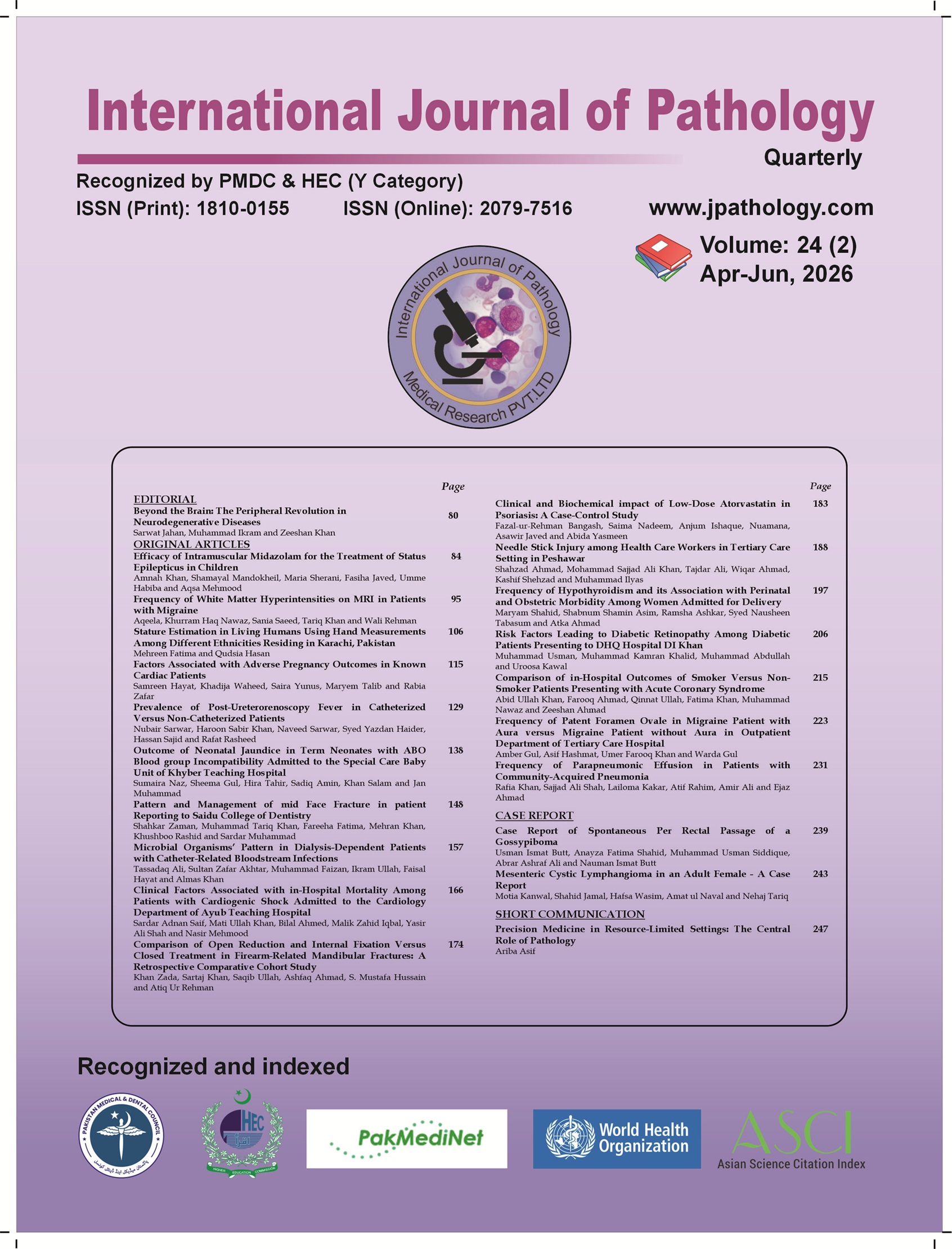
Additional Files
Published
Issue
Section
License
Copyright (c) 2026 Rafia khan, Sajjad Ali shah, Lailoma Kakar, Atif Rahim , Amir Ali, Ejaz Ahmad

This work is licensed under a Creative Commons Attribution-NonCommercial 4.0 International License.
Readers may “Share-copy and redistribute the material in any medium or format” and “Adapt-remix, transform, and build upon the material”. The readers must give appropriate credit to the source of the material and indicate if changes were made to the material. Readers may not use the material for commercial purpose. The readers may not apply legal terms or technological measures that legally restrict others from doing anything the license permits.