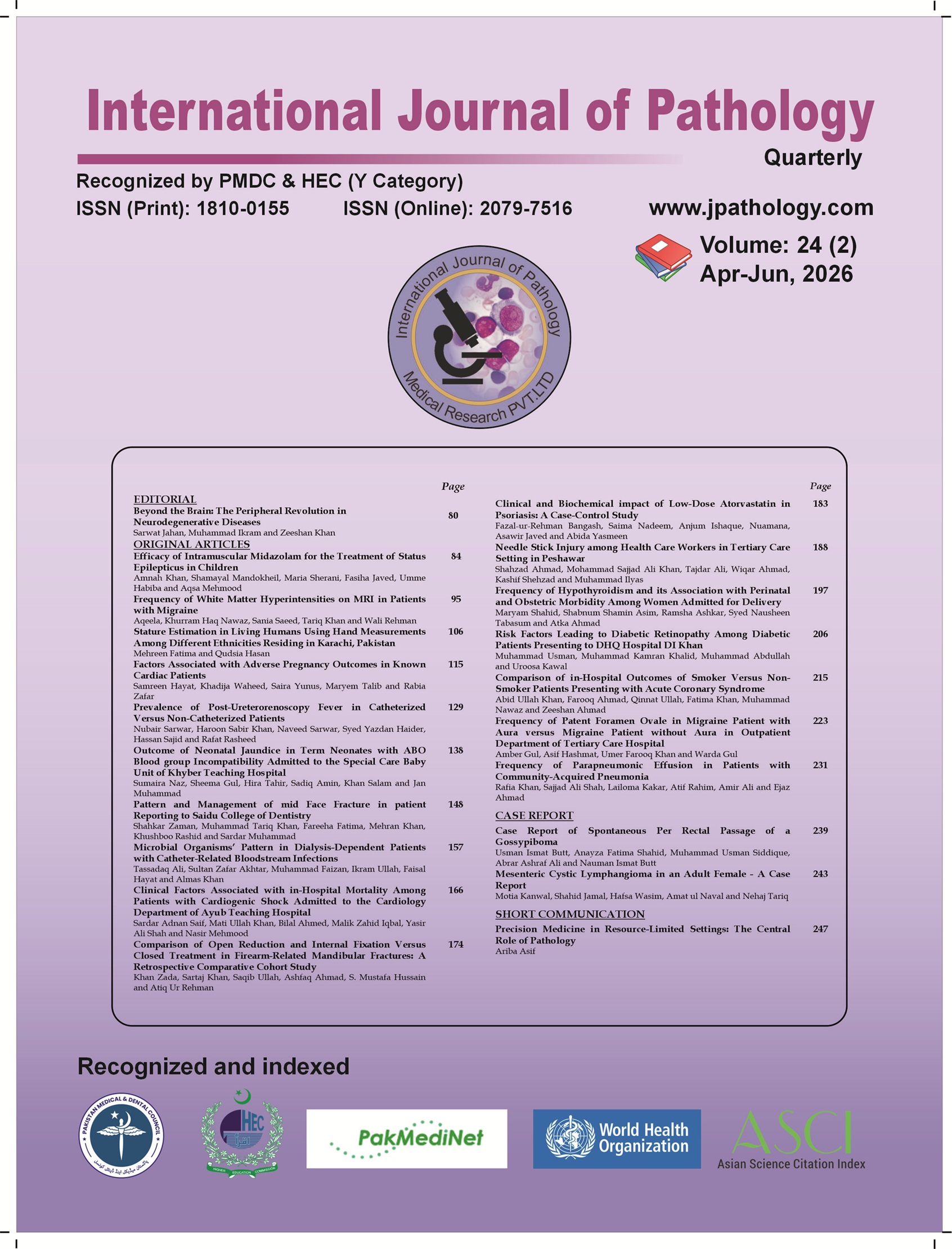
Outcome of neonatal jaundice in term neonates with ABO blood group incompatibility admitted to the special care baby unit of Khyber Teaching Hospital
DOI:
https://doi.org/10.59736/IJP.24.02.1092Keywords:
ABO incompatibility, Exchange Transfusion, Hyperbilirubinemia, Intravenous Immunoglobulin, Neonatal Jaundice, PhototherapyAbstract
BackgroundNeonatal jaundice is a common condition affecting newborns worldwide, with more than 50% of term and up to 80% of preterm infants developing hyperbilirubinemia. Although most cases are physiological, ABO blood group incompatibility is an important pathological cause resulting from maternal anti-A or anti-B antibodies crossing the placenta and causing hemolysis of fetal red blood cells. Affected neonates may develop early-onset jaundice, anemia, reticulocytosis, and severe hyperbilirubinemia, which can lead to bilirubin encephalopathy if not treated promptly. This study was conducted to evaluate the clinical outcomes, treatment interventions, and complications among term neonates with ABO incompatibility admitted to Khyber Teaching Hospital.
Methods
This descriptive study was conducted in the Department of Pediatric Medicine, Khyber Teaching Hospital, Peshawar from March 2026 to June 2026. A total of 210 term neonates with confirmed ABO incompatibility were included. Demographic details, laboratory parameters including total serum bilirubin, hemoglobin, reticulocyte count, and direct antiglobulin test (DAT), treatment modalities, complications, and duration of hospital stay were recorded and analyzed.
Results
Phototherapy was required in 150 (71%) neonates, intravenous immunoglobulin (IVIG) was administered to 45 (21%), and exchange transfusion was performed in 20 (9%). Anemia developed in 30 (14%) neonates, while bilirubin encephalopathy occurred in 5 (2%). Inferential analysis demonstrated that DAT-positive neonates were significantly more likely to require IVIG and exchange transfusion and had significantly longer hospital stays than DAT-negative neonates (p < 0.05).
ConclusionABO incompatibility remains a significant cause of neonatal jaundice among term infants. Early diagnosis, close monitoring, and timely therapeutic interventions are essential to prevent severe hyperbilirubinemia and associated complications.
References
Zinjani S. Common medical conditions in the neonates. In: Saha U, editor. Clinical anesthesia for the newborn and the neonate. Singapore: Springer; 2023. p. 49-70. doi:10.1007/978-981-19-5458-0_4.
Ochigbo S, Ekpebe P, Nyong EE, Ikechukwu O, Ibeawuchi A, Eigbedion A, et al. Neonatal jaundice incidence, risk factors and outcomes in referral-level facilities in Nigeria. BJOG. 2024; 131:113–24. doi:10.1111/1471-0528.17596
Warsame HA, Theuri C, Abdullahi NM, Ahmed Keynan AM, Ahmed MA. Prevalence and risk factors for neonatal jaundice: A multicentre analytical cross-sectional study at neonatal intensive care units, Mogadishu, Somalia. BMJ Open. 2025;15(3): e096692. doi:10.1136/bmjopen-2024-096692
Okulu E, Erdeve O, Kilic I, Olukman O, Calkavur S, Buyukkale G, et al. Intravenous immunoglobulin use in hemolytic disease due to ABO incompatibility to prevent exchange transfusion. Front Pediatr. 2022; 10:864609. doi:10.3389/fped.2022.864609
Lin H, Luo P, Liu C, Lin X, Que C, Zhong W. Risk of low levels of blood group antibodies mediating hemolysis in ABO-incompatible neonates with negative three hemolysis tests. Front Pediatr. 2024; 12:1392308. doi:10.3389/fped.2024.1392308
Watchko JF. ABO hemolytic disease of the newborn: A need for clarity and consistency in diagnosis. J Perinatol. 2023;43(2):242–7. doi:10.1038/s41372-022-01564-4
Mahapatra S, Patra K, Panda S, Behuria S, Sahu PK, Majhi MM. Hyperbilirubinemia in neonates with blood group incompatibilities: A bane or a boon for the management. Transfus Clin Biol. 2025;32(1):82–86. doi: 10.1016/j.tracli.2024.10.003
Kumbhar S, Musale M, Jamsa A. Bilirubin metabolism: Delving into the cellular and molecular mechanisms to predict complications. Egypt J Intern Med. 2024;36(1):34. doi:10.1186/s43162-024-00298-6
Abbas SH, Nafea LT, Abbas RS. Prevalence of ABO incompatibility and its effect on neonatal hyperbilirubinemia. Res J Pharm Technol. 2020;13(1):141–6. doi:10.5958/0974-360X.2020.00028.9
Jamil A, Ikram F, Nawaz R, Mumtaz S, Hussain M, Ateeq S. Frequency of ABO incompatibility in neonates as cause of neonatal jaundice admitted in a neonatal unit of tertiary care hospital. Pak Armed Forces Med J. 2024;74(3):703–6. doi:10.51253/pafmj.v74i3.10984
Gabbay JM, Agneta EM, Turkington S, Bajaj BM, Sinha B, Geha T. Rates of phototherapy among ABO-incompatible newborns with a negative direct antiglobulin test. J Perinatol. 2023;43(11):1357–62. doi:10.1038/s41372-023-01744-y
Lieberman L, Lopriore E, Baker JM, Bercovitz RS, Christensen RD, Crighton G, et al. International guidelines regarding the role of IVIG in the management of Rh- and ABO-mediated haemolytic disease of the newborn. Br J Haematol. 2022;198(1):183–95. doi:10.1111/bjh.18164
Wu K, Chen L, Huang H, Chen D. A comparative analysis of the efficacy of blood exchange therapy in neonatal hyperbilirubinemia induced by ABO and Rh incompatibility. Int J Gen Med. 2024; 17:5921–7. doi:10.2147/IJGM.S489241
Sharma S, Sapkota B. Predictive value of cord blood bilirubin for hyperbilirubinemia in term neonates with ABO incompatibility. Nepal J Health Sci. 2024;4(1):100–11. doi:10.3126/njhs. v4i1.64121
Alshammari S, Alqashami A, Alhumud S, Aladadh M, Alsaif S, Ali K. Neonatal ABO incompatibility, influence of blood group, and Coomb's test on outcome. J Clin Neonatol. 2022;11(4):212–8. doi: 10.4103/jcn.jcn_47_22
Slusher TM, Vaucher YE. Management of neonatal jaundice in low- and middle-income countries. Paediatr Int Child Health. 2020;40(1):7–10. doi:10.1080/20469047.2019.1691157
Thakur AK, Ansari MA, Mishra A, Jha SK. Outcome of neonatal jaundice in term neonates with ABO incompatibility at tertiary level center. Int J Contemp Pediatr. 2020;7(10):1973–7. doi:10.18203/2349-3291.ijcp20204123
Sellouti M, Ayad A, Abilkassem R, Agadr A. Neonatal hyperbilirubinemia due to ABO incompatibility.JPediatr Neonatol. 2023;4(3):1038. doi:10.46889/JPN.2023.4304
Kumar Krishnegowda V, Ramaswamy VV, Abiramalatha T, Bandyopadhyay T, S AK, Kannan Loganathan P. Direct antiglobulin test for the prediction of neonatal hyperbilirubinemia needing an intervention: A systematic review and diagnostic test accuracy meta-analysis. Front Pediatr. 2025; 12:1475623. doi:10.3389/fped.2024.1475623
Kemper AR, Newman TB, Slaughter JL, Maisels MJ, Watchko JF, Downs SM, et al. Clinical practice guideline revision: Management of hyperbilirubinemia in the newborn infant 35 or more weeks of gestation. Pediatrics. 2022;150(3): e2022058859. doi:10.1542/peds.2022-058859
Additional Files
Published
Issue
Section
License
Copyright (c) 2026 Sumaira Naz, Sheema Gul, Hira Tahir, Sadiq Amin, Khan salam, Jan Muhammad Afridi

This work is licensed under a Creative Commons Attribution-NonCommercial 4.0 International License.
Readers may “Share-copy and redistribute the material in any medium or format” and “Adapt-remix, transform, and build upon the material”. The readers must give appropriate credit to the source of the material and indicate if changes were made to the material. Readers may not use the material for commercial purpose. The readers may not apply legal terms or technological measures that legally restrict others from doing anything the license permits.